
Market Activity
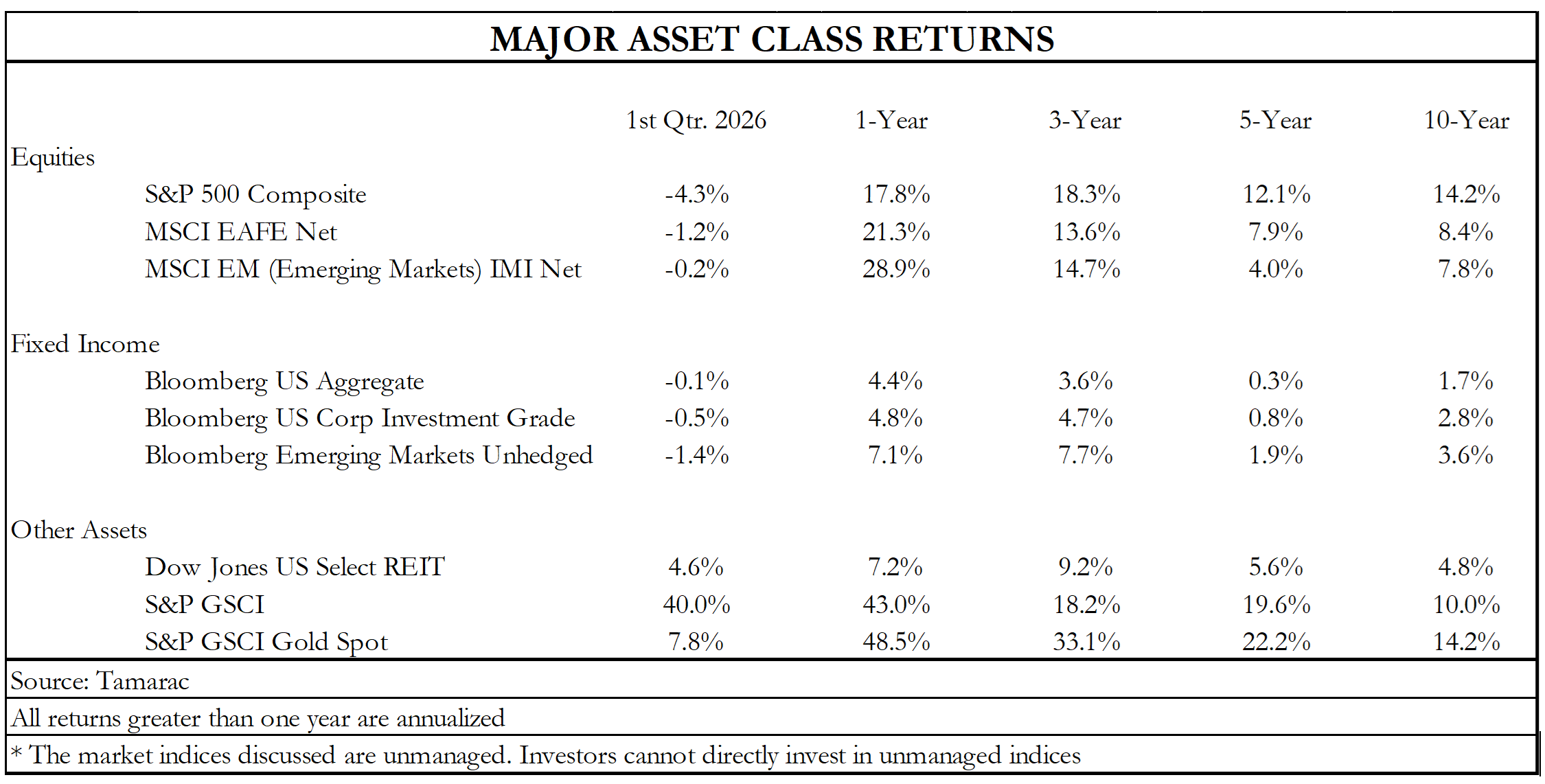
Global markets entered 2026 on solid footing, with many of the trends from 2025 carrying forward. However, U.S. and Israeli strikes on Iran disrupted the landscape and introduced significant uncertainty.
During March, markets experienced sharp cross-asset movements: the U.S. dollar strengthened, energy prices surged, inflation expectations rose, and interest rate assumptions were reset. The S&P 500 experienced an intra-quarter drawdown of approximately 8.5%, ultimately resulting in a negative return for most asset classes in the first quarter. Interestingly, the S&P 500 ended Q1 2026 with the same return as the first quarter of last year, though the drivers were markedly different.
In fixed income, the 10-year Treasury yield rose modestly, but the more notable move occurred at the short end of the curve. The 2-year Treasury yield increased by 32 basis points as investors scaled back expectations for rate cuts. Credit-sensitive sectors underperformed yet still offer relatively limited compensation for the additional risk.
Economic Activity
The onset of conflict with Iran has shifted the global economic outlook. Growth expectations have been revised downward, while inflation expectations have moved higher.
The Organisation for Economic Co-operation and Development, which had been preparing to raise its global growth forecasts in March, now expects those tailwinds to reverse. At the same time, it has increased its inflation outlook for the G20 economies, raising its 2026 forecast by 1.2% to 4.0%.
Prior to these developments, economic momentum had been building. The Citi Economic Surprise Index was on track for its longest stretch of positive surprises since the post-financial crisis recovery. This underlying strength should help cushion some of the newly introduced headwinds.
In the United States, manufacturing is showing signs of revival. Both industrial production and the ISM Purchasing Managers’ Index (PMI) have improved, with PMI readings exceeding 52 throughout the first quarter. This marks the strongest stretch since August 2022, when the economy was benefiting from stimulus-driven demand and robust employment growth.
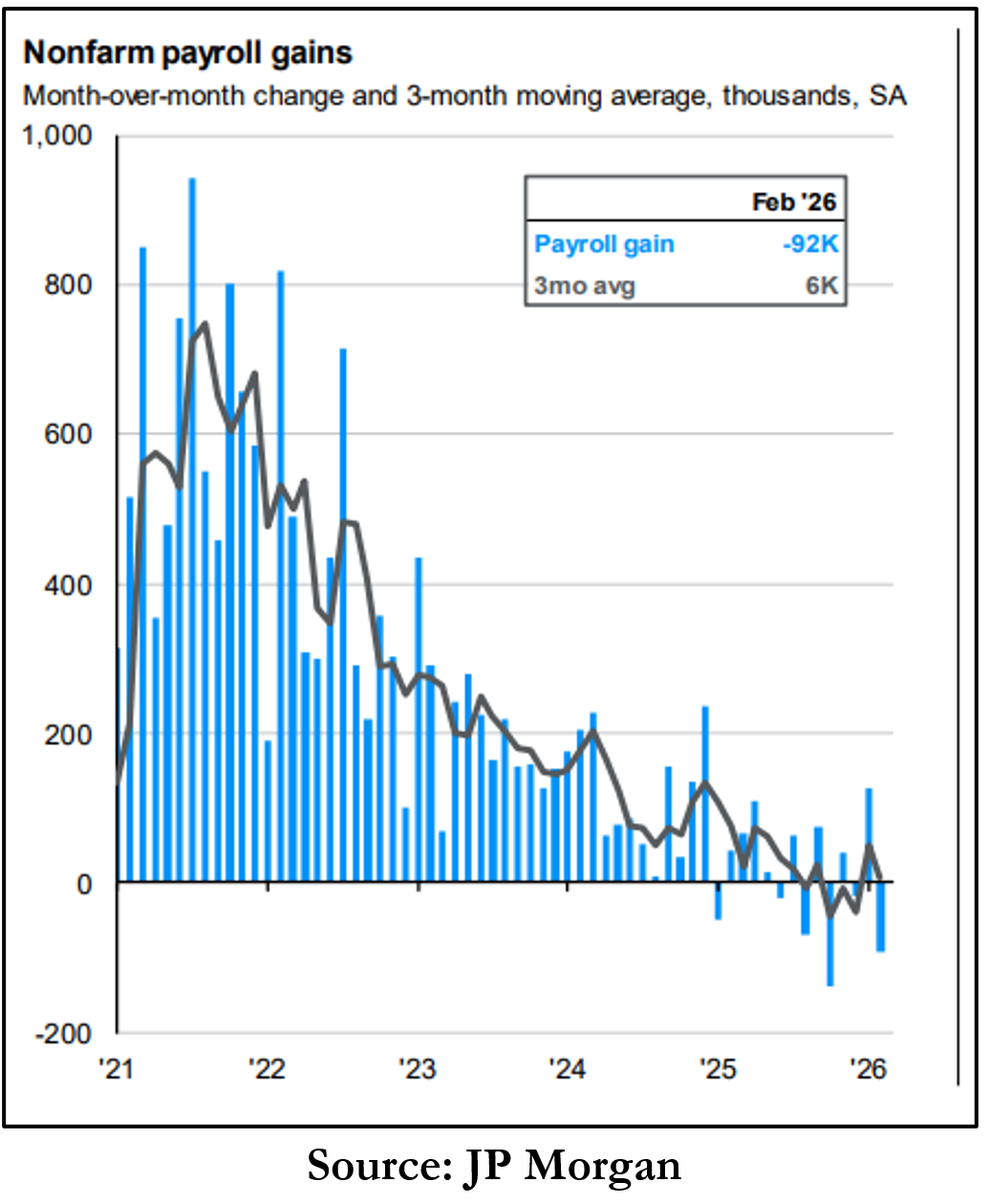
However, the broader economy is increasingly reliant on labor market strength. With excess pandemic savings largely depleted and job openings returning to more typical levels, sustained consumption depends on continued job creation. The first quarter presented a mixed picture: positive payroll gains in January and March were offset by a sharply negative reading in February. As a result, the six-month average of nonfarm payroll growth has slowed to below 15,000 jobs per month, down significantly from 121,000 in 2024.
Monetary Policy
The most immediate market impact from the conflict has been on interest rate expectations. At the start of the year, investors broadly anticipated stable or declining policy rates. That view has shifted meaningfully. Markets are now pricing in potential rate increases over the next 12 months.
In the U.S., expectations for rate cuts have been reduced by approximately 0.50%. In Europe, expectations for the European Central Bank have moved from no change to an increase of 0.75%. The Bank of England has seen one of the most dramatic shifts, from expectations of two rate cuts to now pricing in two rate hikes. These moves have only partially reversed after the announcement of a ceasefire.
Adding to the uncertainty is an unusual level of political tension surrounding the Federal Reserve. President Trump announced Kevin Warsh as his preferred nominee for Fed Chair in March. However, the confirmation process remains uncertain, with Senator Thom Tillis indicating he may withhold support pending the outcome of a Department of Justice investigation into current Chair Jerome Powell.
Powell has stated he intends to remain in his role until the matter is resolved. While the situation has introduced an element of political drama, our expectation is that a Warsh-led Federal Reserve will eventually take shape, with minimal disruption to policy continuity.
Valuation and Sentiment
Equity valuations have improved modestly. The forward price-to-earnings ratio for the S&P 500 has declined below 20x, a welcome development for long-term investors. However, valuation must be viewed in the context of earnings reliability. Given the uncertainty surrounding geopolitical developments, confidence in forward earnings estimates may be lower than usual.
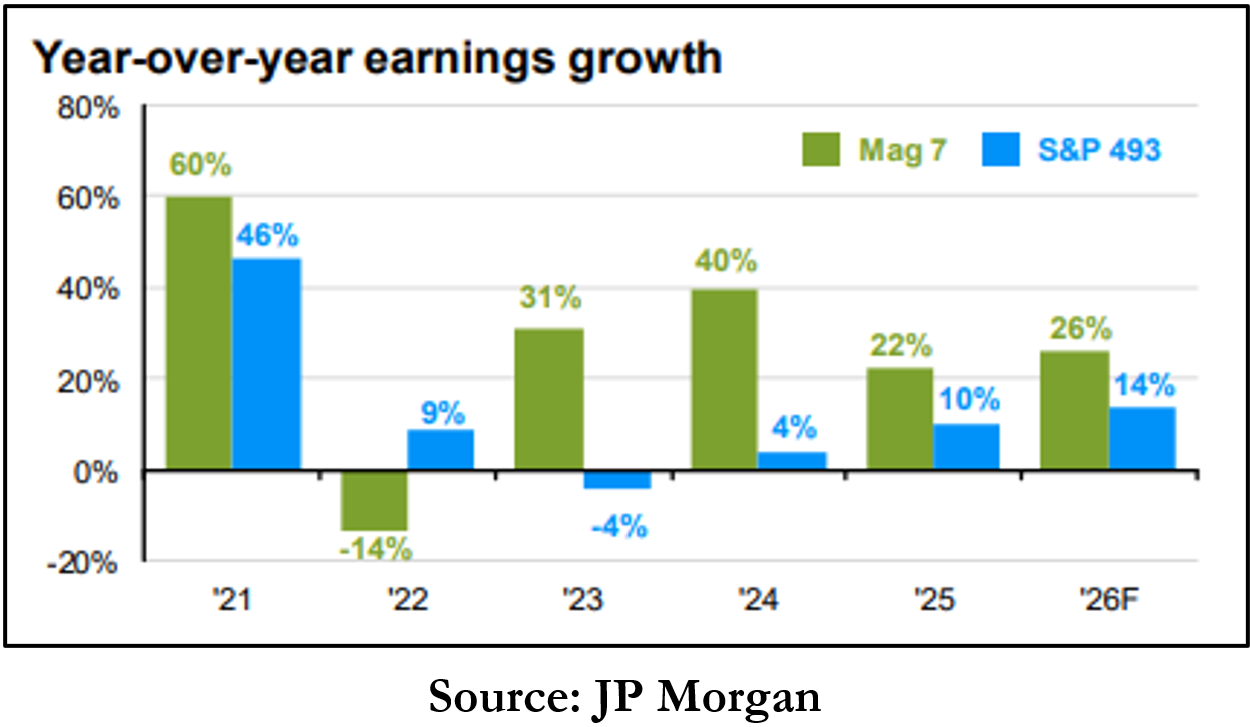
Another notable shift has been the underperformance of the “Magnificent Seven” stocks—Alphabet, Amazon, Apple, Meta, Microsoft, Nvidia, and Tesla—all of which lagged the broader market during the quarter. This occurred despite continued expectations for strong earnings growth, suggesting a shift in investor sentiment rather than fundamentals.
The Investment Outlook
The Middle East Conflict
As of this writing, the U.S., Israel and Iran have agreed to a two-week ceasefire which should see hostilities end and allow ships to transit through the Strait of Hormuz. Markets globally breathed a sigh of relief, with crude oil and the U.S. dollar falling and stocks and bonds rallying. While success for the ceasefire and longer-term plans for peace remain uncertain, public comments from both sides are at least reinforcing the same message, a welcome change from the experience of the past few weeks.
The basis for future negotiations, expected to start on April 10th, is a 10-point plan sent to the U.S. by Iran. Items including U.S. military withdrawal from the Middle East and continued Iranian control over the Strait of Hormuz may be a difficult chasm to bridge. Also complicating the future is what Israel finds acceptable. In the immediate hours after the ceasefire declaration ships are still not transiting the Strait, but this is chalked up as a temporary phenomenon as captains await clarity on the situation. Prediction markets have greatly increased the probability, now 65%, that traffic in the Strait returns to prewar levels by the end of May.
For markets, this is a positive first step, yet we expect continued volatility as the details get ironed out.
Private Credit: Growing Scrutiny
Separately, private credit has come under increasing scrutiny since mid-2025, with recent developments accelerating investor concern.
Some funds have begun restricting redemptions as investor withdrawals increase. These vehicles often allow quarterly liquidity of up to 5% of net asset value. When redemption requests exceed this threshold, withdrawals are prorated, limiting investor access to capital. In many respects, these mechanisms are functioning as intended. Forced selling of illiquid assets would likely result in significant value destruction for both exiting and remaining investors.
The private credit market has grown substantially, with approximately $600 billion being held in vehicles accessible to individual investors. For context, U.S. commercial banks hold approximately $13.5 trillion in loans and leases.
However, the interconnectedness of the system warrants close attention. Banks have extended roughly $300 billion in credit to private credit funds, and life insurers hold approximately 35% of their investments in private credit. If capital flows reverse, key questions emerge around refinancing capacity, funding costs, and potential spillover effects.
Final Thoughts: Balanced Positioning
Geopolitical risks, private credit dynamics, and the continued expansion of artificial intelligence remain central themes for markets.
At present, we do not believe these developments warrant significant changes to portfolio positioning. Today, we have structured portfolios to be neutral from a shorter term (6 to 12 months) risk-perspective with future moves likely to be more defensive over a longer period (12 to 24 months). At the same time, we remain attentive to evolving opportunities and risks as the year progresses.
Navigating Social Security
Deciding when to claim Social Security retirement benefits is a complex and highly personal decision. While 68% of workers expect to retire at age 65 or older, only 31% work that long (J.P. Morgan). There are several key factors that can help retirees maximize lifetime income while aligning benefits with their financial needs and life circumstances.
One of the key factors is understanding the impact of timing. Individuals can begin claiming benefits as early as age 62, but doing so results in a permanent reduction, often up to 30%, compared to waiting until full retirement age (FRA is typically 67 for those born in 1960 or later). The annual cost-of-living adjustment (COLA) will also be lower, as COLA is based on the amount of your benefit. Delaying benefits beyond FRA, however, increases payments by about 8% per year until age 70, making it a powerful tool for boosting guaranteed lifetime income.
Another key concept is the “break-even point,” which compares the total benefits received from claiming early versus delaying. While estimates vary, J.P. Morgan recommends claiming benefits at 62 if you do not expect to live past 77. If you expect to live beyond age 81 then consider waiting until age 70 to file. According to the Social Security Administration, a 62-year-old man has a 71% chance of living to at least age 77 and a 58% chance of living to age 81. Women have even higher life expectancy rates.
Married couples also have some strategic opportunities to consider. One such strategy is having the lower-earning spouse file for benefits early, at FRA or earlier, to help cover immediate expenses, while allowing the high-earner’s benefits to grow by up to 8% per year. This strategy also enables couples to maximize their survivor benefits. A surviving spouse who has reached FRA is eligible for 100% of the deceased spouse’s benefit, even if the deceased spouse waited until age 70 to take their benefit.
It is important to integrate Social Security into a broader retirement plan. Taxes, investment income and withdrawals, and overall cash flow all influence optimal benefit timing. For instance, when coordinating retirement accounts and personal (non-retirement) accounts, it may make sense to begin taking benefits early in a down market to avoid the cardinal sin of investing – being forced to sell good equities in a weak market. Though some retirees believe they can achieve greater returns on their portfolio when deciding to take their benefits earlier, it is difficult to overcome Social Security’s annual COLA plus guaranteed 8% annual delayed benefit increase.
Lastly, retirees should avoid making decisions based on fear or uncertainty about the financial future of Social Security. Simply stated, given political repercussions, future leaders will continue to fund benefit payments in the years ahead.
The best Social Security claiming strategy depends on a combination of timing, health, income needs, and long-term financial goals. Please view us as a resource for your financial planning needs and, as always, contact us if we may be of assistance in any manner.
DISCLOSURES – This presentation is not an offer or a solicitation to buy or sell securities. The information contained in this presentation has been compiled from third party sources and is believed to be dependable; however, its accuracy is not guaranteed and should not be relied upon in any way whatsoever. This presentation may not be construed as investment advice and does not give investment recommendations. Any opinion included in this report constitutes the judgment of Lincoln Capital Corporation as of the date of this report and are subject to change without notice. Additional information, including management fees and expenses, is provided on Lincoln Capital Corporation’s Form ADV Part 2. As with any investment strategy, there is potential for profit as well as the possibility of loss. Lincoln Capital Corporation does not guarantee any minimum level of investment performance or the success of any portfolio or investment strategy. All investments involve risk (the amount of which may vary significantly) and investment recommendations will not always be profitable. The investment return and principal value of an investment will fluctuate so that an investor’s portfolio may be worth more or less than its original cost at any given time. The underlying holdings of any presented portfolio are not federally or FDIC-insured and are not deposits or obligations of, or guaranteed by, any financial institution. Past performance is not a guarantee of future results. Lincoln Capital Corporation prepare presentation, 401.454.3040, www.lincolncapitalcorp.com Copyright © 2026, by Lincoln Capital Corporation.
